
An open correspondence by Prof. Dr. Martin Daumer and Prof. Dr. Jörn Rittweger
Published by SLCMSR e.V. – The Human Motion Institute
zenodo.org/records/19810885 (Zenodo DOI)
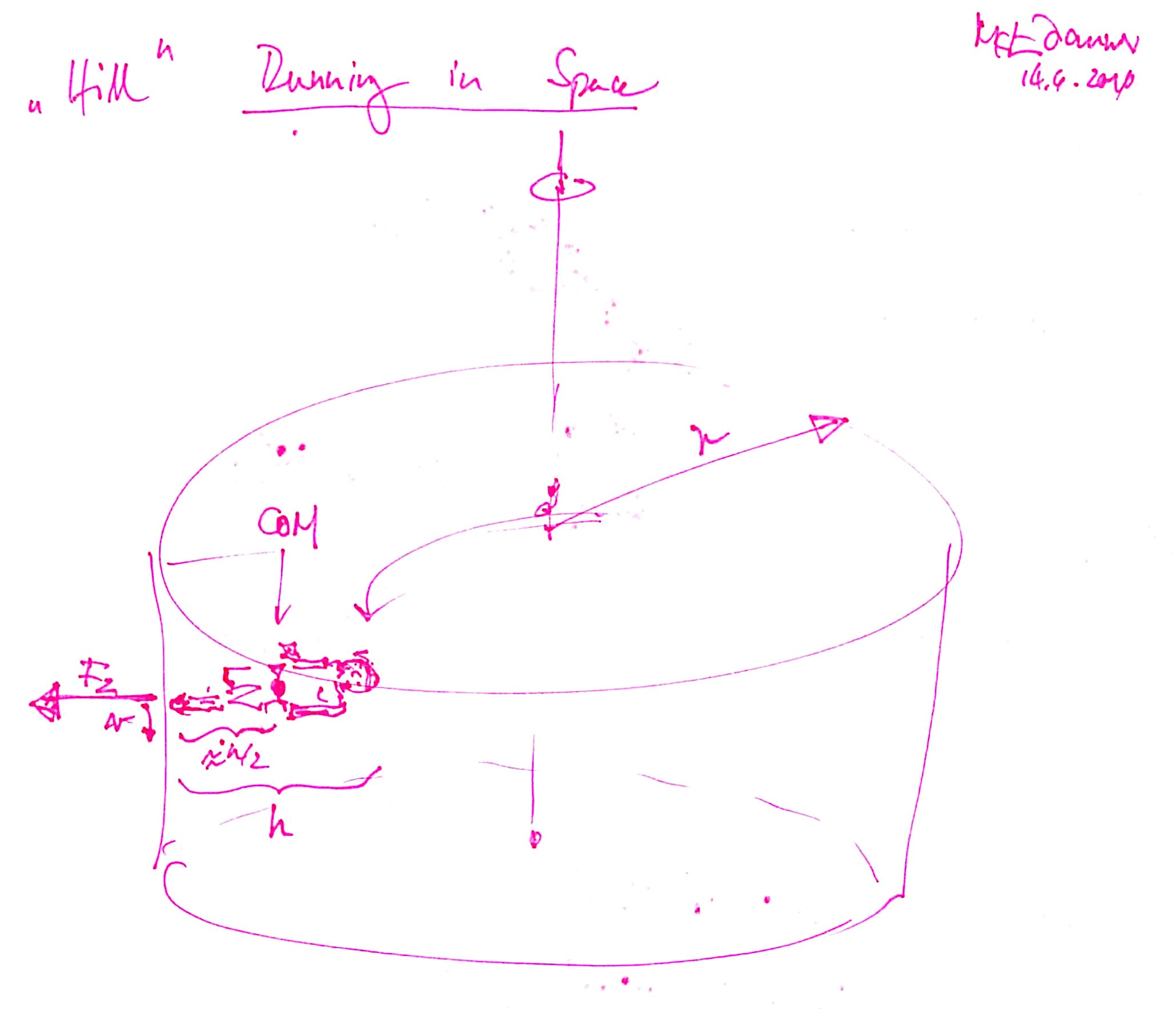
The use of centripetal acceleration generated by locomotion within rotating or curved structures has been discussed as a potential approach to simulating gravitational loading during long-duration spaceflight. In this context, we wish to make publicly available a set of preliminary calculations and conceptual sketches developed in June 2016, exploring the feasibility of generating partial- to full-gravity conditions through running along the inner surface of cylindrical and conical structures.
The enclosed materials originate from an internal exchange between Martin Daumer and Jörn Rittweger on 14 June 2016. The correspondence includes first-principles derivations of the required track radius as a function of running speed, body height, and target gravity fraction, alongside considerations of stride geometry, angular momentum transfer to the habitat, and the distinction between cylindrical (constant-radius) and conical (variable-radius) configurations.
These calculations suggest that, for typical endurance running speeds of 3-4 m/s and a track diameter of 4-5 meters, the resulting vertical displacement per stride would remain within a biomechanically acceptable range of approximately 10-16 cm, contingent on appropriate running technique that minimizes vertical push-off.
The materials are presented here in their original form to document the early development of this concept within our group.
pubmed.ncbi.nlm.nih.gov/38716331